Revolutionizing Edge AI: An In-Depth Look at the Raspberry Pi 5 and the Hailo-8L AI Kit
The landscape of single-board computing (SBC) underwent a seismic shift with the release of the Raspberry Pi 5. While the jump in CPU and GPU performance was significant, the most transformative addition was the integrated PCIe 2.0 interface. This small connector opened the door to high-speed hardware expansion that was previously impossible. Chief among these expansions is the Raspberry Pi AI Kit, featuring the Hailo-8L M.2 AI accelerator. Often referred to in the community alongside various M.2 HATs (Hardware Attached on Top), this combination—frequently dubbed the “Hailo+HAT” setup—has effectively turned the Raspberry Pi into a professional-grade edge AI deployment tool.
The Genesis of the Hailo-Pi Partnership
For years, the Raspberry Pi was a platform for learning and light automation. When it came to Artificial Intelligence, specifically Computer Vision (CV), the Pi relied on its ARM-based CPU to crunch numbers. This resulted in “slideshow” frame rates; a Pi 4 might manage 2 or 3 frames per second (FPS) running a modern object detection model like YOLO (You Only Look Once).
External USB accelerators, like the Intel Movidius, offered a temporary fix but were often bottlenecked by USB latency and driver instability. The Raspberry Pi 5 changed the game by allowing a direct “brain-to-brain” connection via PCIe. By partnering with Hailo—an Israeli chipmaker specializing in Neural Processing Units (NPUs)—Raspberry Pi provided a native, high-bandwidth solution that makes AI processing as seamless as plugging in a keyboard.
Under the Hood: The Hailo-8L NPU
At the heart of the AI Kit is the Hailo-8L. While the full-sized Hailo-8 is designed for industrial servers, the “L” (Light) version is optimized for the power and thermal constraints of the Raspberry Pi.
Despite being the “light” version, its specs are staggering for its size:
- Performance: 13 Tera Operations Per Second (TOPS).
- Power Efficiency: Typically consumes less than 2 watts.
- Architecture: Unlike a GPU, which is a general-purpose processor forced to do math, the Hailo NPU uses a Structure-Defined Dataflow Architecture. It physically mimics the structure of a neural network in its hardware, allowing data to flow through layers with almost zero latency.
When compared to the Raspberry Pi 5’s CPU, the Hailo-8L is roughly 10 to 20 times faster at executing inference tasks while using a fraction of the electricity.
The Anatomy of the “HAT+2” Configuration
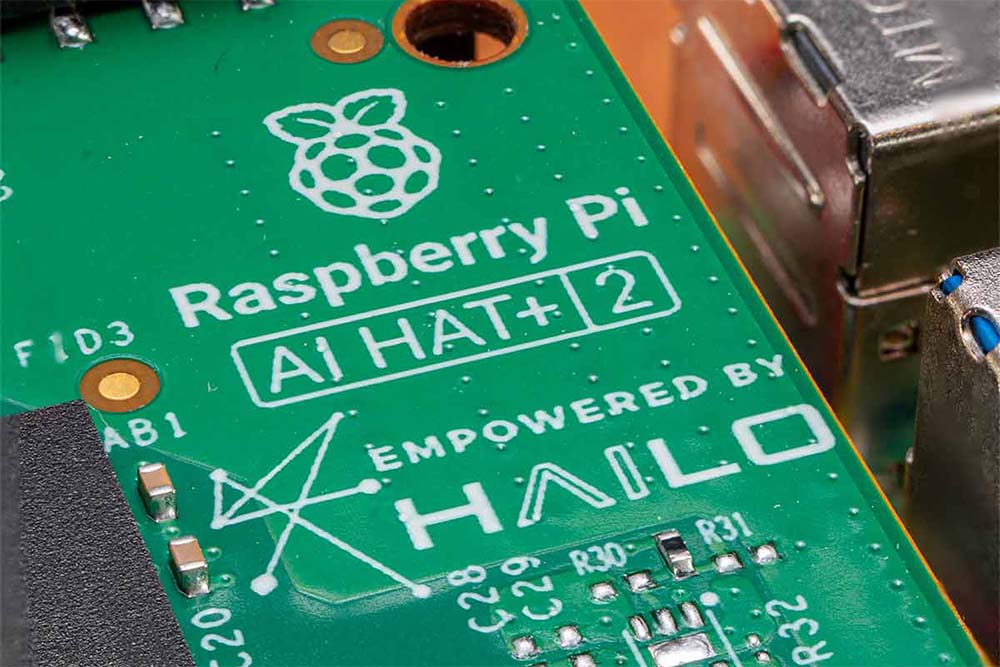
To use the Hailo module, you need a bridge. This is where the M.2 HAT+ comes in. The “HAT+” is the new standard from the Raspberry Pi Foundation, designed to sit on top of the Pi 5 and convert the 16-pin PCIe ribbon cable into an M.2 M-key slot.
The “Hailo+2” terminology often arises when users utilize a dual-slot HAT or the specialized “Raspberry Pi AI Kit” bundle. This hardware stack includes:
- The Raspberry Pi 5: The host controller.
- The M.2 HAT+: The physical interface board.
- The Hailo-8L Module: The M.2 card that performs the AI math.
- The Active Cooler: Essential for managing the heat generated when both the Pi’s Broadcom chip and the Hailo chip are running at full tilt.
Software Integration: The Secret Sauce
Hardware is useless without accessible software, and this is where the Raspberry Pi ecosystem shines. Historically, setting up AI accelerators required compiling complex libraries from source. For the Hailo-8L, Raspberry Pi integrated the drivers directly into the Raspberry Pi OS.
By running a simple sudo apt install hailo-all, the system installs:
- HailoRT: The runtime environment.
- Tappas: Hailo’s high-level application framework.
- rpicam-apps: This is the most impressive part. The standard camera applications on the Pi (like
rpicam-stillandrpicam-vid) now have “post-processing” blocks. This means you can run an object detection model with a single command line flag. You don’t need to write a single line of Python to see the Pi start identifying people, cars, and dogs in real-time.
Real-World Applications
The combination of the Pi 5 and Hailo-8L isn’t just for hobbyists; it’s being used in genuine industrial and commercial sectors.
1. Smart Security and Surveillance
Traditional security cameras record everything, filling up hard drives with hours of empty footage. A Pi+Hailo system can act as a “smart gatekeeper.” It can distinguish between a swaying tree branch and a human intruder, only triggering an alert when a specific object is detected. Because the processing happens “at the edge” (locally on the Pi), no video is ever sent to the cloud, ensuring total privacy.
2. Advanced Robotics and Drones
Robots need to “see” to navigate. A drone equipped with a Hailo-8L can perform real-time obstacle avoidance and path planning. Since the NPU handles the vision, the Pi’s CPU remains free to handle flight controls and communication, ensuring the system doesn’t lag or crash.
3. Industrial Quality Control
On a conveyor belt, a Pi 5 with the AI Kit can inspect thousands of items for defects. Whether it’s checking for bruised fruit or missing screws in a circuit board, the 13 TOPS of performance allows the system to keep up with high-speed production lines that would baffle a standard computer.
Performance Benchmarks: Seeing is Believing
To truly understand the impact, look at the FPS (Frames Per Second) benchmarks for Yolov8s, a popular object detection model:
- RPi 5 CPU Only: ~1–2 FPS (Unusable for real-time).
- RPi 5 + Hailo-8L: ~60–90 FPS (Butter smooth).
This massive delta means the Pi is no longer just “trying” to do AI; it is doing it at a level that rivals dedicated desktop workstations from only a few years ago.
Challenges and Considerations
While the Hailo+HAT setup is powerful, it isn’t without its quirks.
- Thermal Management: The PCIe interface and the NPU generate heat. Using the Raspberry Pi Active Cooler is mandatory. In fanless enclosures, the Hailo module can throttle, reducing its TOPS performance.
- Power Supply: The Raspberry Pi 5 requires a high-quality 5V/5A power supply to provide enough current for both the board and the PCIe expansion. Using an older Pi 4 power supply will often result in system instability.
- PCIe Gen 3: While the Pi 5 is officially rated for PCIe Gen 2, it can be “overclocked” to Gen 3. While this increases bandwidth for SSDs, the Hailo-8L doesn’t strictly need it, and Gen 3 can sometimes introduce electrical interference.
The Future of the Raspberry Pi AI Ecosystem
The Raspberry Pi AI Kit is just the beginning. We are already seeing third-party manufacturers creating “Multi-HATs” that allow for both an NVMe SSD and a Hailo NPU simultaneously. This allows the Pi to act as a high-speed AI server—storing vast amounts of data on the SSD while the Hailo chip processes it in real-time.
Conclusion
The Hailo-8L and the M.2 HAT+ represent the maturation of the Raspberry Pi. By offloading the heavy lifting of mathematical tensors to a dedicated silicon chip, the Pi 5 is liberated to do what it does best: coordinate, communicate, and control. Whether you are a researcher, a tinkerer, or an industrial engineer, the “Hailo+HAT” configuration is the most cost-effective and power-efficient way to bring high-performance intelligence to the edge of the network.